Overview
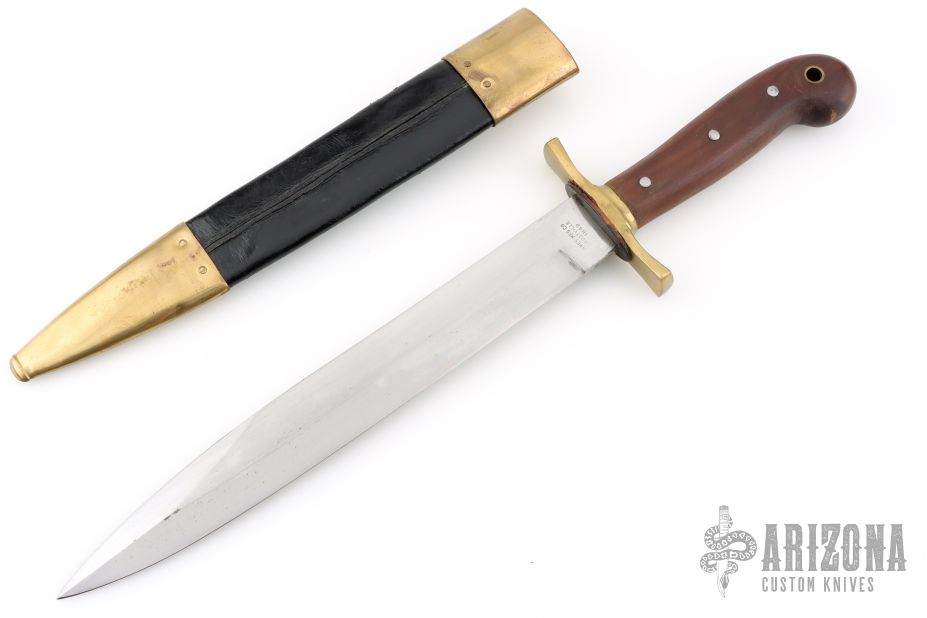
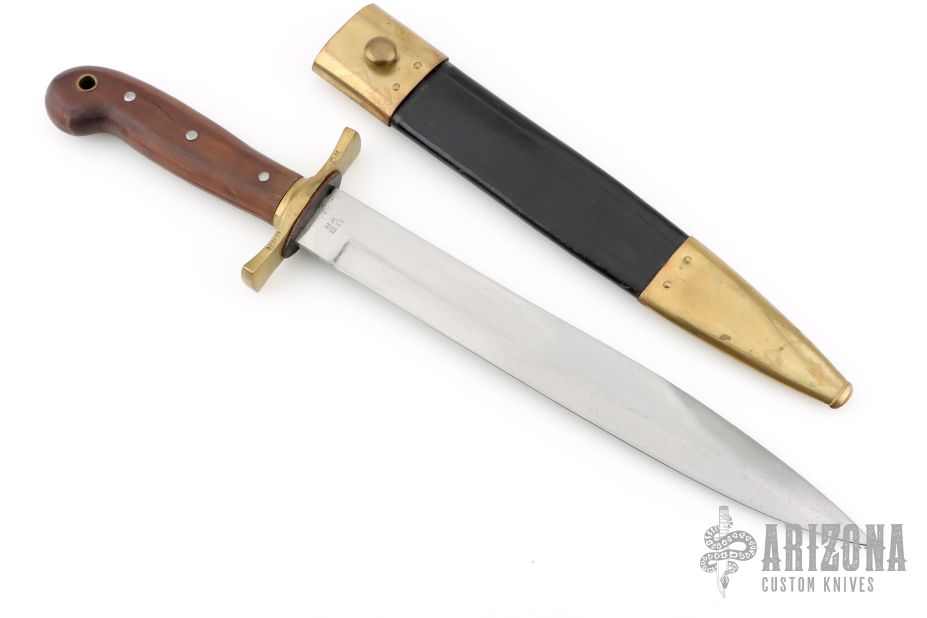
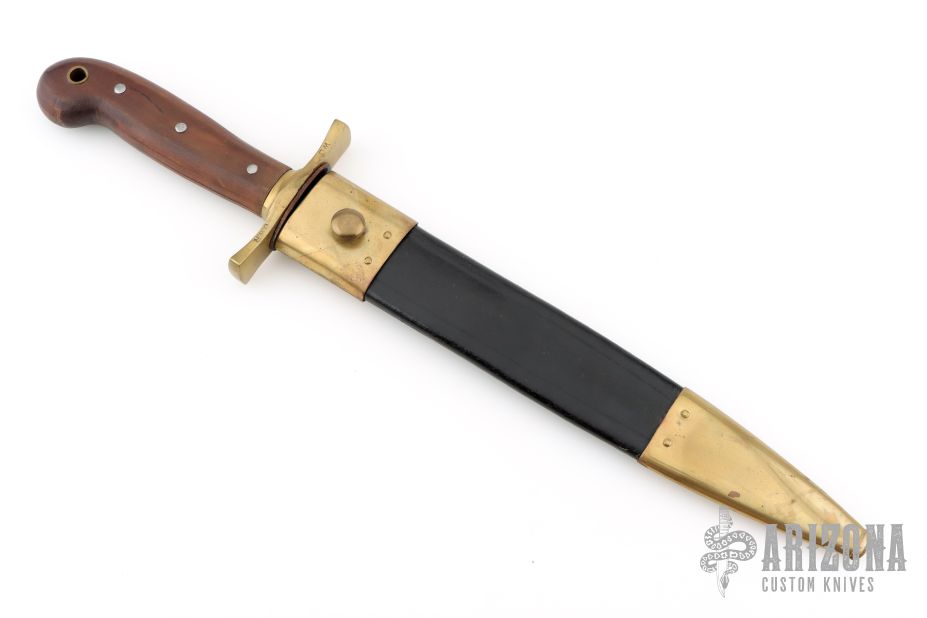
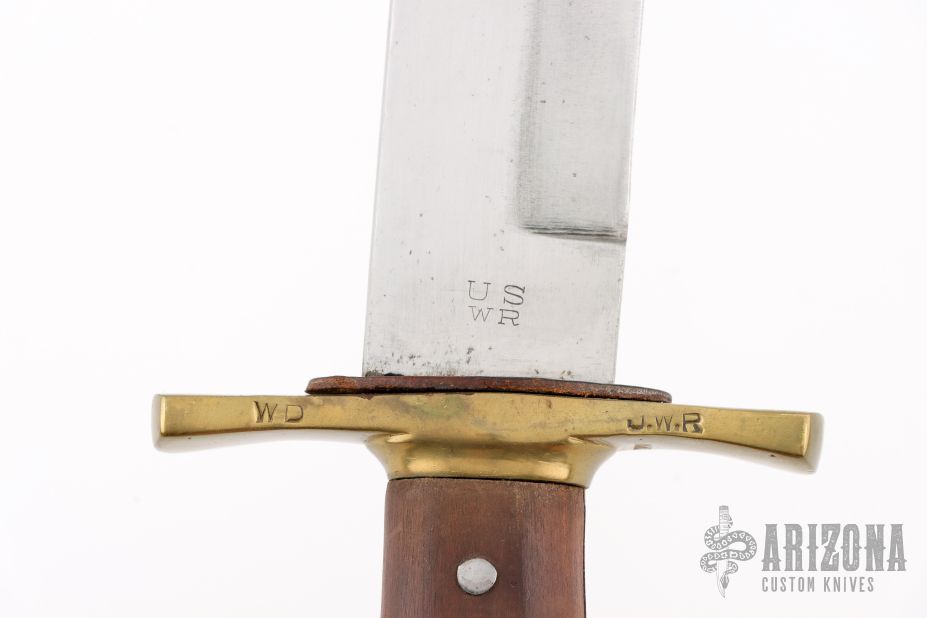
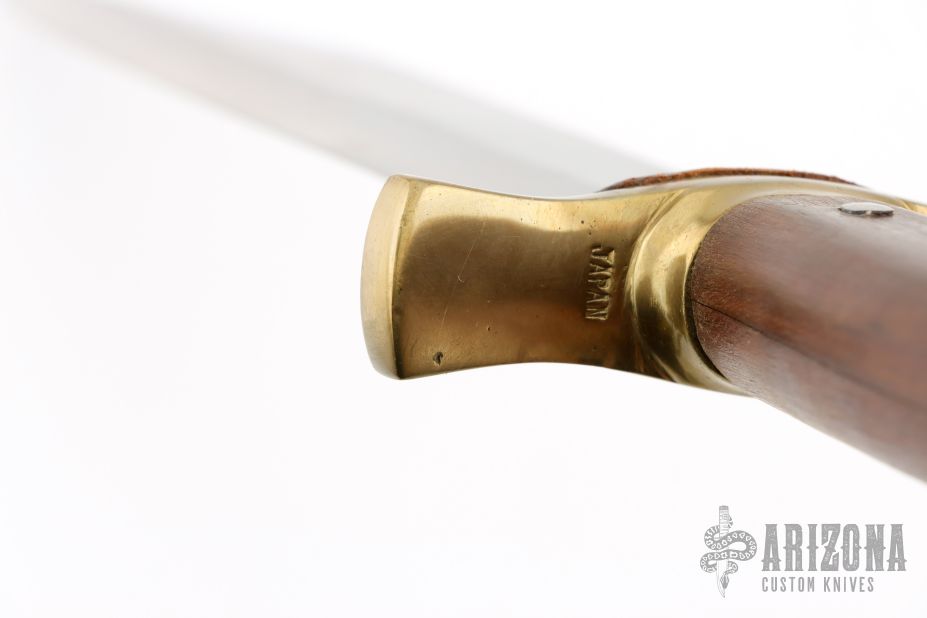
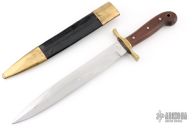
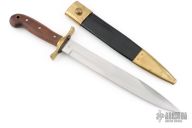
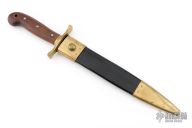
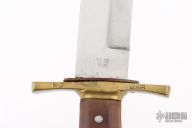
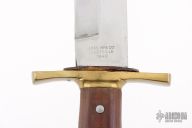
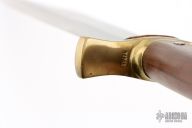
This knife is in remarkable condition considering its age. It has some light scratches and patina, a small separation in the handle at the top and bottom, otherwise excellent condition. Comes with original scabbard that is also in excellent condition. Stamped JAPAN on the guard.
The below information came from HERE.
The 1849 Rifleman's Knife
This is the one, the grand daddy of them all, considered by many to be the first Official U.S. Military Fighting Knife. Actually designed and approved in 1848 it took over a full year to produce and ship the 1000 knives ordered. The reason for this long wait was due to the huge number of presentation swords being ordered at the time. The Mexican War was recently on and the rush to decorate all the gallant soldiers of the era took precedence in the manufacturing process. Congress and various State Militia's had commissioned many swords made of Gold and Silver which kept the Ames Manufacturing Co. booked for a year in advance.
In 1847 Nathan P. Ames passed away, which gave way for James T. Ames, his brother and stockholding manager, to operate the company. In late 1847 James proposed several design's of knives for mounted troops in regards to a contract about to be let by the U.S. Government. The most rugged and heaviest of the design's was selected by the War Department as the knife to be produced. A contract was signed on March 8th of 1848 for the procurement of 1000 of these Mounted Rifleman's Knives with matching scabbards. Unfortunately in several previous letters to the War Department it had been explained that production capability was far behind in orders. Apparently the Mounted Rifleman's Knife took a low priority to all the presentation swords being produced at the time. The knives were finally delivered to the U.S. Arsenal on May 5th 1849 at a price of $4.00 each .
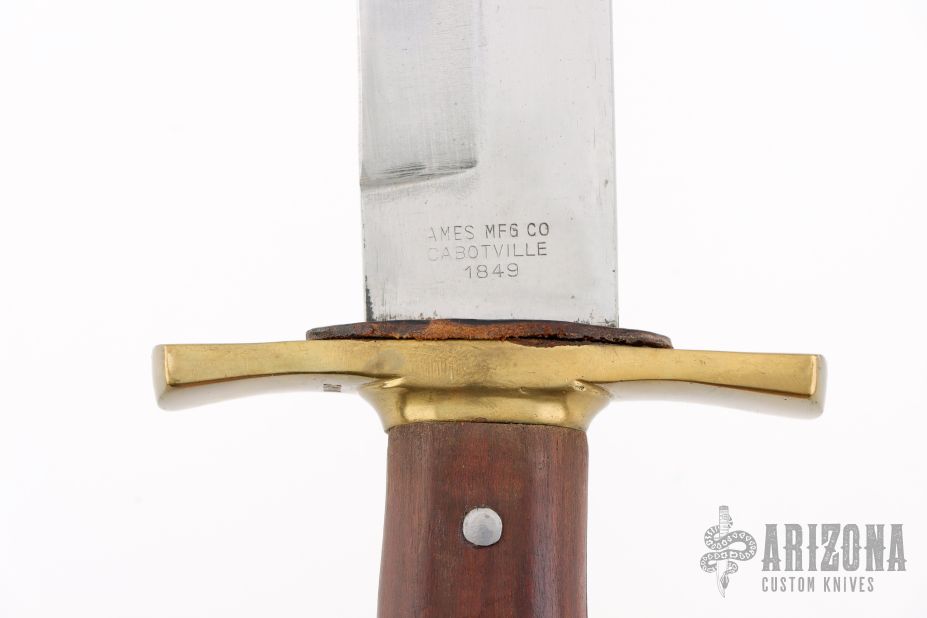
The Rifleman's Knife is a very large piece. Total length is 18 inches, the blade is 11 3/4 inches in length ,1 5/8 inches in width and 1/4 inch thick. The blade is non fullered and has a central ridge running full length to the spear shaped point. It is single edged with a 3 inch false edge running up the back. The walnut handles were routed to accept the blade tang and were held in place by three brass rosette headed rivets installed from the obverse side. A thin brass ferrule was passed through the end of the grip to allow an attachment of a wrist thong. This was deemed necessary when mounted to prevent dropping and loosing the weapon. The handles were finished by shaving the corners to a more rounded or oval feel. Of the knives I have examined no two handles are exactly alike owing to the hand made, rather than machine made, fit and finish. The guard was made of solid brass and is 3 7/8 inches in overall length and tapered to meet the handle. The markings on the knife are as follows: Obverse Ricasso " AMES MFG. CO. / CABOTVILLE / 1849" Reverse Ricasso " U.S. / W.D.". The reverse guard is stamped with "WD" and "JWR". These are the initials of the Arsenal inspectors of the time, William Dickinson and Major James W. Ripley. It's interesting to note that these may have been the last products to have been stamped with the CABOTVILLE logo. The records show that the stamping at Ames Mfg. Co. was changed in 1848 to "Chicopee / Mass". This change was due to the incorporation of tiny Cabotville into the larger township of Chicopee. One can only speculate why the marks are as they are. Were the blades made in 1848 and finished in 1849 or was this due to the pattern being Cabotville so all the production, in order to be approved, followed suit? The scabbard was a black leather affair with brass mounted throat and chape. The throat held a brass stud for attachment to a leather belt frog.
Due to the extreme rarity of these knives the best chance you will have of seeing one is in a museum. In many years of military knife collecting I can only remember seeing two for sale. While the 1849 Mounted Rifleman's Knife would absolutely make the centerpiece in any military knife collection, the price is definitely not for the weak of heart. These knives have been collectors items for many years, Francis Bannerman advertised the 1849 Rifleman's Knife in his 1927 catalog as a "rare weapon" and a "museum exhibit". The price including scabbard was $20.00. These knives have been reproduced in recent years so approach with caution, buy only from a reputable dealer who is willing to refund your money at any time should any questions be raised.
I remember the first time I saw a Rifleman's Knife was in Larry Thomas' American Military Edged Weaponry Museum. I just stood there for awhile looking at it. Larry wandered over and started telling me about that particular knife. We both agreed if only the knife could tell us it's story, now that would make one interesting article.
This information came from the Rock Island Auction Company.
Only 1,000 of these knives were purchased by the Ordnance Department from the Ames Manufacturing Co. in 1849 for issue to the U.S. Regiment of Mounted Riflemen. The Model 1849 Rifleman's Knife has the distinction of being the first knife officially designed and purchased by the U.S. Army. The massive knife is 18 inches long and has an 12 inch spear point blade, cast brass cross guard marked with "WD" (William Dickinson) and "J.W.R." (General James Wolfe Ripley) inspection marks, and slab-sided walnut grips with a distinctive brass lined thong hole in the pommel and three steel rivets. Between 1842 and 1854, James Ripley was Superintendent of the Springfield Armory in Massachusetts and later the head of the Ordnance Department at the beginning of the Civil War. The knife is complete with the original black leather scabbard with brass throat and tip. The throat has a round frog stud. The obverse ricasso of the blade is stamped with a "US" property mark over "WD," and the reverse is roll-stamped "AMES MFG. CO./CABOTVILLE/1849" in three lines. The U.S. Regiment of Mounted Riflemen was originally authorized by an Act of Congress on December 1, 1845 and organized in the fall of 1846. They fought during the Mexican-American War, primarily armed with Colt Dragoon revolvers and U.S. Model 1841 rifles. Because the Model 1841 rifles did not have provisions for bayonets and they did not carry traditional cavalry sabers, the men needed suitable blades. The Model 1849 has similarities to other fighting knives from the era and was very well made. The Mounted Riflemen were sent to the Oregon Territory in 1849 and were subsequently assigned to garrisons in California. Many of the men deserted during the California Gold Rush, then at its peak. The unit was redesignated the 3rd Cavalry Regiment at the start of the Civil War, and many of the Model 1849 Rifleman's Knives that were still serviceable saw use during the conflict. The 3rd Cavalry has been a part of many of the most important moments in U.S. military history since its creation. The 4th Squadron is still known as "Longknife." Provenance: The George Moller Collection