
Overview
This info is from the College Hill Arsenal about a very similar knife:
At the beginning of World War II, the US military had no official fighting knife designated for issue and the only knives in inventory were some World War I era Model 1918 Mk1 brass knuckle knives and some Model 1917 Trench Knives. While both models had been acquired in relatively large numbers during the Great War, many were sold off as surplus when the war was over. The US Model 1905 Bayonet in service when the US entered World War II after the Japanese attack on Pearl Harbor on December 7, 1941, had a 16” blade that did not lend itself to doing double duty as a fighting or utility knife. The need for such a knife was obvious, but it would be nearly a year before any fighting utility knives were being acquired by the military for general issue.
The men going off to war were often aware that a sturdy knife was an essential piece of equipment for both fighting and camp chores. To fill the void left by the initial inability of the US military to provide its fighting men with knives, hundreds of small makers and retailers got into the business of making and providing knives to service men about to ship overseas. Iconic names like Randall, Cole, Ruana, Nichols, Richtig and Huff were only a few of the custom knife makers who stepped up to provide fighting knives. Some companies like San Antonio Iron Works and Knife Crafters created an industry of converting old sabers into fighting knives and some makers like Murphy and Barteau used discarded surplus aluminum and saw blades to craft fighting knives.
Ben Rocklin (1877-1955) of Chicago, IL was another cutler who answered the call of his adopted country to help equip the fighting men with sturdy fighting knives. Rocklin was Russian Jew who had emigrated to American with his family when he was a boy. Census and emigration records are somewhat muddled as to when Rocklin was born in Russia, with dates between 1875 and 1880 given in various documents. The most reliable source of information is likely Rocklin’s World War I Draft Registration Card. That form lists Rocklin’s birth date as December 15, 1877. It further describes him as have a medium physical build, black hair and blue eyes. Rocklin’s date of emigration is listed variously as 1887 and 1891. This indicates that the Rocklin family likely fled Russia as a result of the series of anti-Jewish pogroms that started to take place during the 1880s. Some two million Russian Jews left their homeland, primarily for the United States between 1880 and 1920. The Rocklin family was almost certainly part of that forced emigration and at least one document notes that Benjamin Rocklin had made an application for an emergency passport to enter the United States through the Japanese consulate. The 1900 Federal Census lists “Bennie” Rocklin living with his parents and nine brothers and sisters at 89R West 13th Street in Chicago’s 7th Ward. The Census lists his emigration year as 1891 but has his year of birth listed as 1879. He is listed as being employed as a “Basket Maker”. By the 1910 Census Rocklin was married, living on his own at 560 13th Street in Chicago’s 9th Ward with his wife and six children and his occupation was listed as a “Grinder” who was working from his home. By 1920 little had changed for the Rocklins other than there were seven children living at home and the family had moved to the 20th Ward and was as 1244 Newberry Ave. Ben was still working as a “Grinder,” “on his own account.” However, Rocklin was much more than just a “grinder”. By 1920 Chicago newspapers were small announcements and advertisements for Rocklin’s cutlery. The February 24, 1940, edition of the Chicago Tribune ran an announcement under the large type “LATEST INVENTION” and followed with “Solid tempered, stainless steel table knives. No scouring. Water, lemons, or any other fruit acid will not tarnish them. Money refunded if stain, tarnish or rust. Write for prices and particulars. Ben Rocklin Knife Works, 1244 Newberry-av. Chicago.”
By the 1930 Census Rocklin’s occupation was listed simply as “Knives”, his industry as “Factory” and he was still “Working on own account.” The 1940 Census found Rocklin in his early 60s, still working some 56 hours a week “on his own account” and listing his highest level of education as “Elementary school, 2nd grade.” With the outbreak of the Second World War, Rocklin apparently pivoted from producing table ware to making fighting knives. The beginning of the change in production is noted in a July 30, 1941, Chicago Tribune announcement that read:
Man – To sell knives ground from steel files. 746 S. Halsted. Call a.m. Ben Rocklin.
A more detailed July 7, 1944, announcement in the Chicago Tribune read:
Commando fighting knives – For service men: mfg. by Ben Rocklin Knife Works. 746 S. Halsted st., Tel. Monroe 1740. Call a.m. only.
Rocklin noted in an interview in the April 6, 1945, issue of Yank magazine that he manufactured and sold some 6,000 “Jap Stickers” to soldiers and marines. He was described as a “one-man commando knife factory” and even referred to himself as a “one-man arsenal of democracy” who produced the knives for the soldiers when his adopted country was threatened. In another interview Rocklin waxed eloquent about fighting the Japanese when he was in the Russian Imperial Army. This seems to be mere bloviating, as Rocklin had been living in the United States for 9 years according to the 1900 Census, and it is highly unlikely that he returned to Russia in his late 20s to fight in the Russo-Japanese War of 1904-1905. It would be quite odd for a man whose family was run out of the country by the anti-Jewish sentiment of the country to return to it to fight for it.
Rocklin passed away on March 23, 1955, at the age of 77 years old. His obituary noted that he was the father of nine children and had eight grandchildren and that his beloved wife had preceded him in death. Rocklin was a hardworking man who emigrated to the United States with his family to escape persecution, made a life for himself, lived the American dream and raised a large American family. He was a patriotic supporter of his adopted country and worked hard to support the war effort in the best way he could. In many ways Rocklin was the poster child for opportunity that the United States offers to the hard-working immigrant, and it seems strangely appropriate that his name is not lost to the trash bin of history as World War II fighting knife collectors still know who he was and value the knives that he made.
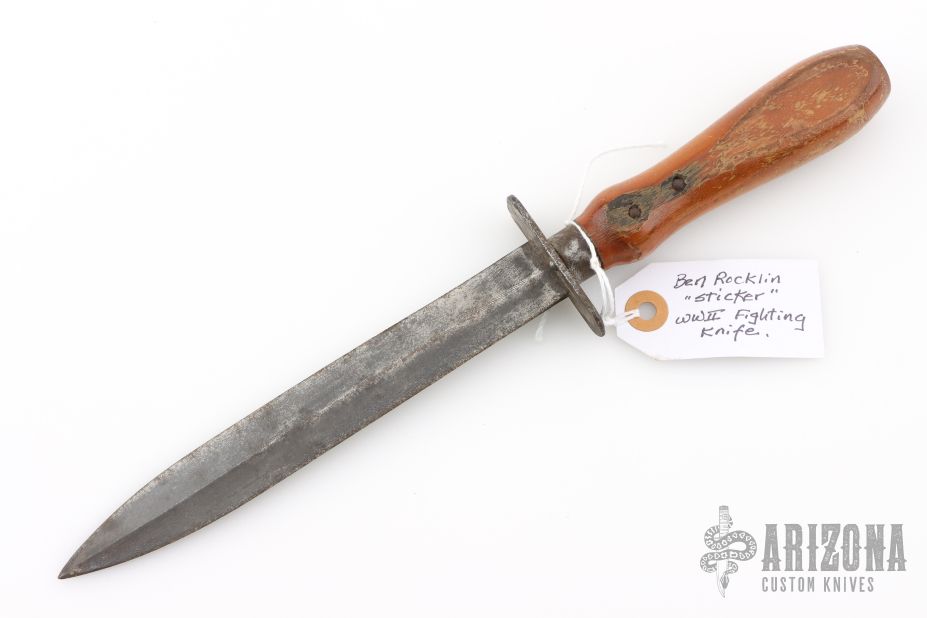
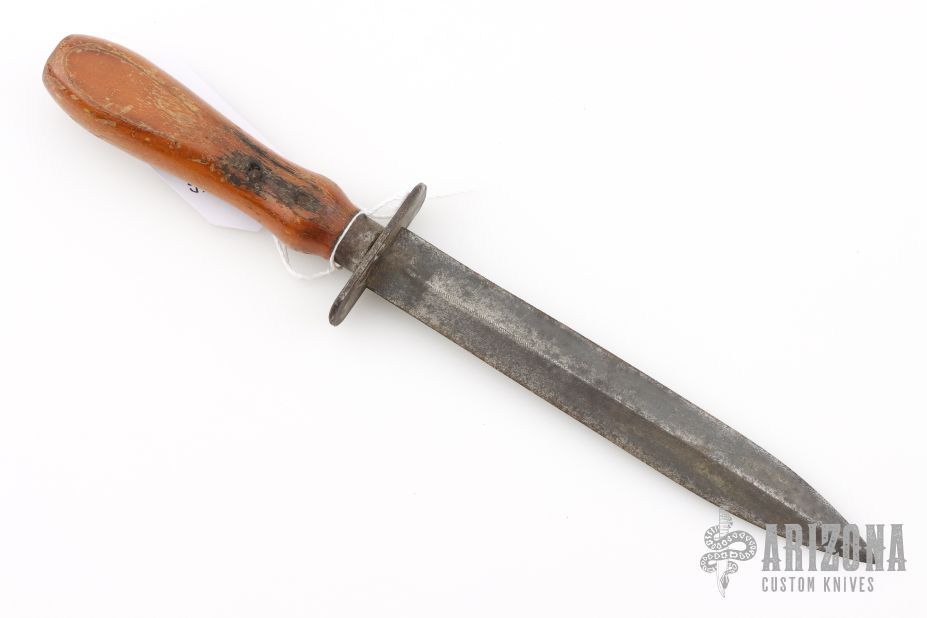
According to Bill Walter’s exhaustive book U.S. and Allied Military Knives World War II – Book II, Rocklin produced two versions of his “Sticker” fighting knife, with the only real difference being the length of the guard. Rocklin’s knife was a double-edged dagger made from a file with a nominally 8” long, 1” wide blade and with an overall length of nominally 13”. The grip was turned wood the flattened sides that varied in length and style and was pinned to the tang. The grip shape was reminiscent of hand tools of the period and makes sense for a maker who had been a general cutler and had been making a variety of knives and similar items before the war. A 3/8” steel ferrule was used at the rear of the guard and beginning of the grip. The blued steel guards were nominally 2 ¼” long by 7/8” wide on the first version or 3 ½” long on the second version. Both versions were supplied with a rivet reinforced sewn leather sheath with a hilt retention strap. Buckle straps were apparently most common, but snap secured snaps have been noted as well. Like most knife makers of the era, it is likely Rocklin simply purchased the sheaths from an assortment of suppliers, rather than making them himself.
This example of a Ben Rocklin “Sticker” Commando Knife offered here has a blade made from a file that measures 7.5” in length and is 1” wide at the ricasso, hidden tang construction. The overall length of the knife is 12.75” with a 5" pinned, turned wood grip and a 2.25” long by 7/8” wide steel guard. The grip is shaped like the two examples shown in Bill Walter’s book, with larger, more prominent flats. The knife is unmarked, as are all examples that are documented. Has some rust and oxidation, some dings and wear on the handle, otherwise good condition for its age.
Overall, this is a good example of one the lesser-known private purchase American fighting knives from World War II. While Rocklin does not have the name or reputation of the heavy hitters like Randall and Cole, he was just as patriotic and determined to help with the American war effort. Rocklin’s background and back story make these knives even more intriguing and tell a poignant story about the American dream realized by a Jewish immigrant who was escaping persecution. This seems a particularly appropriate story to tell as anti-Semitic protests erupt around the country.