



Overview
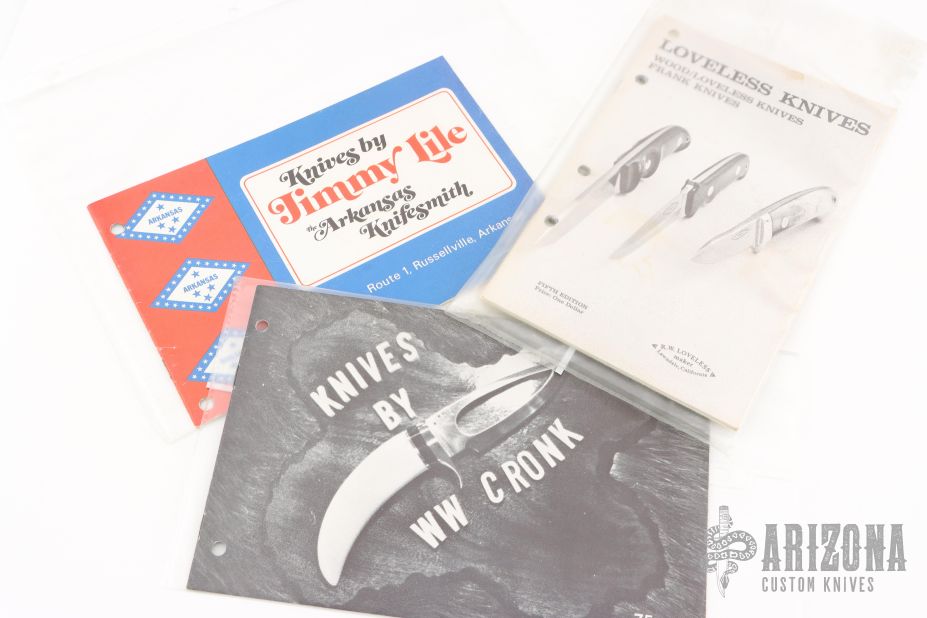
Vintage Knife Makers Catalogs and Literature
Any customers with separate shipping and billing addresses are subject to follow up contact. If no contact can be made, your order will be cancelled. Please understand that this policy is to protect our customers from fraud and theft.
Shipping costs are calculated automatically when you checkout. Orders to P.O. Boxes or military addresses require shipping via USPS.
Orders placed by 3:00pm EST will be shipped the same day. All orders shipped USPS (including Express) may take an additional business day to process and ship. We strongly recommend shipping UPS if you need guaranteed delivery by a certain date.
For our international customers, you must call or email after ordering to arrange for duties/customs and declarations before we will ship your order. USPS Express International shipments with declarations greater than $200, incur an additional $15.00 fee for postage/insurance.
By placing an order the buyer represents that he or she is of legal age and that the products ordered will be used in a lawful manner. We assume no responsibility for any harm or injury resulting from the sale, trade, use or handling of any product purchased from us. It is the responsibility of the buyer, not the seller, to ascertain and obey all applicable local, state, federal and international laws in regard to the possession, and or use, of any item purchased. We are unable to provide refunds in the event that the package that you have ordered was seized by customs or other agencies. Consult your local and state laws before ordering if you are in doubt.
We offer a layaway plan on select products so you may pay for your order over a period of 60 days. Products that are eligible for layaway will show "Layaway Available: Yes" on the product page.
The total amount of the order excluding shipping, tax, or fees is divided into three (3) equal payments. The first payment is due with the order, the second payment is due 30 days later, and the final payment is due 60 days after the order.
There is a $15 non-refundable fee for layaway orders. This fee is added to the first payment along with the shipping and any tax. The first payment is made when the order is placed.
Example: Your order total is $300 plus $12.75 shipping and handling. If you select the layaway option, your payments would be:
If your initial payment is made by credit card, we will automatically process the 2nd and 3rd payments at the appropriate time using the same credit card information. You will be reminded via email that a payment will be charged. If you need to change this for any reason, please contact us.
For payments made other than credit card, payment must be received within seven (7) days of the due date or the order is subject to cancellation. You will receive a reminder via email that a payment is due.
If you wish to complete payment early and have your order shipped, you may contact us at any time during the 60 day period. There is no penalty for prepayment.
Additional products may be added to a layaway order without penalty. A new payment schedule will be calculated based on when additional products are added.
If you wish to complete payment early and have your order shipped, you may contact us at any time during the 60 day period. There is no penalty for early payment.
Cancellations of layaway orders are subject to a restocking/processing fee of 10% of the order total (not including tax and shipping costs). This restocking fee is in addition to the $15 non-refundable layaway fee.
Price $595.00
Vintage Knife Makers Catalogs and Literature
Weight (oz) 20
Source Previously owned
The late Harvey Draper was a well-known and well-respected knifemaker. Harvey was from Ephraim UT and made his first knife with Gil Hibben in the mid-1960's. Harvey died in a plane crash in 1982. He is remembered in part through the knives he made which have remained in the hands of collectors.
Robert Waldorf Loveless (January 2, 1929 – September 2, 2010), a.k.a. Bob Loveless or RW Loveless, was an American knife maker who designed and popularized the hollowground drop point blade and the use of full tapered tangs and screw-type handle scale fasteners within the art of knifemaking. A hunting knife on the table of nearly any American knifemaker today will show the influence of knifemaker Bob Loveless. In the beginning he turned the knife industry on its ear, and made modern handmade knifemaking possible. He was at the beginning of everything: The Knifemaker’s Guild, drop point hunters, high quality steels, custom designs, How to Make Knives books, the Japanese Knifemakers Guild, the rise of Japanese cutlery manufacturers, utilizing handmade designs for American manufacturers. You name it and Loveless has had a hand in it. He is cited by other knifemakers and collectors as one of the most innovative custom knife makers in the world. Inducted into the Blade Magazine Cutlery Hall of Fame in 1985.
It’s not enough to say Jimmy Lile was a legend among knifemakers. He made his mark on the custom knife world long before the Rambo movies made him famous. But even more famous was the knife on which he and Sylvester Stallone had collaborated. The knife would become the star of the great movie, Rambo, First Blood. Jimmy and Sly went on to create a second star for the next movie in the series, Rambo, First Blood II, The Mission. These two knives have enjoyed over 3 decades of fame as either model is still coveted in the knife collecting community. Inducted into the Blade Magazine Cutlery Hall of Fame in 1984 and the ABS Bladesmithing Hall of Fame in 1999. Jimmy passed away in 1991.
Billy Mace Imel started making knives in 1973. For the next 48 years with his wife Beverly by his side, Billy would be making, selling and promoting knives – daggers and hunting knives, pocket knives and custom creations. Their journey took them to major shows in New York, Dallas, Paris, Munich and Japan. Billy was a member of the Knifemakers' Guild for 43 years and served as secretary-treasurer for 15 of those. In 1981 Billy was commissioned by the National Rifle Association to make a knife to be presented to President Ronald Reagan, the speaker at the national convention that year. In 1983, he made another for then-Vice President George Bush. An Imel knife is included in a permanent display at the Smithsonian Institution in Washington, D.C. Billy and Beverly Imel were inducted into the BLADE Magazine Cutlery Hall of Fame in 2021.
D.E. Henry was one of the best bowie makers of all time. Henry did his homework in addition to being a near flawless craftsman. He ground his blades from 440C and D2 and didn't have much good to say about forging or pattern welded steel. He was the first to start using a hand rubbed finish and his Sheffield pattern bowies are still some of the best out there. Passed away in 1993.
Lloyd Hale, a skilled knifemaker, has been honing his craft for over fifty years. His journey began in 1967, when he crafted his very first knife. Throughout his career, Hale has demonstrated exceptional artistry and craftsmanship, creating a diverse array of knives, daggers, and swords. Notably, during the 1980s, Lloyd Hale worked in his workshop alongside Owsley Brown Frazier, a prominent figure in the world of gun and arms collecting. Hale’s collaboration with Frazier resulted in the production of over 300 exquisite blades, each a testament to his dedication and expertise. His knives are characterized by intricate details, including stunning inlays of pearl and abalone. Whether it’s a fancy one-of-a-kind folding knife, a meticulously crafted dagger, or a robust sub-hilt fighter, Lloyd Hale’s work stands out as a true feast for the eyes. 98 percent of my blades and fittings steel is 440-C ... back in the 70's I used a little 154-CM but only on request from the buyer.
Dan Dennehy made his first knife in 1941 and started making them for fellow Sailors and for Marines fighting in the South Pacific. One of his achievements in the late 1960s was donating, to the Daughters of the Republic of Texas, first Bowie knife on display at the Alamo in San Antonio, where it still is located in the gift shop museum. Dennehy championed the use of Micarta, a prefabricated material that many knifemakers still use today for their handles. He helped to spread the popularity of the material by telling his friend and foremost knifemaker of the time, Bo Randall, about it - and it caught on quickly throughout the industry. For that and other achievements, he was inducted into the Cutlery Hall of Fame in 2007. In 1970, he was one of the 11 founders of the Knifemakers' Guild, along with prominent knifemakers and friends, Bob Loveless and A.G. Russell. Among the many owners of Dennehy knives were John Wayne, Lee Marvin, Clint Eastwood, Carlos Hathcock, Barry Goldwater, G. Gordon Liddy, musician Steve Miller and many other celebrities. His knives, adorned with the Dan-D shamrock logo, have been used by U.S. military members in every war since World War II. Dennehy was proud that his knives were used by many elite forces including the Navy SEALS, Marine Force Recon and the Army’s Special Forces. Dan passed away in 2011.
Bill Cronk made knives from 1963 until his death in 1983, and is considered to be one of the pioneers of custom knifemaking. His early knives were hunter, skinner, Bowie, fighter and similar patterns. Later in his career he expanded his creations to include knives of more unusual and diverse designs. His early catalogs emphasized that his knives were entirely handmade and hand finished by him alone. Namesake of the prestigious "W.W. Cronk Award" which is awarded annually at the Knifemakers' Guild Show for the knife voted best of show.
William F. "Bill" Moran, Jr. had been forging knives for near twenty-five years when he introduced his re-invention of Damascus steel in 1973. Long before that noteworthy achievement, he had earned the respect of his peers and of knife enthusiasts the world over. Most of Moran's life - the years before he became known as "The Father of Modern Damascus" and those that passed since - has been devoted to the revival of bladesmithing and to the making of knives that have become classics. Among modern day bladesmiths, there is no name better known than that of Bill Moran. Among modern day forged blades, there are none so highly valued as those that have come from his forge during the past half-century. Bill founded the American Bladesmith Society. He is also the namesake of the "Bill Moran School of Bladesmithing" at Texarkana College. Inducted into the Blade Magazine Cutlery Hall of Fame in 1986 and the ABS Bladesmithing Hall of Fame in 1996. Bill passed away in 2006.
John Ek wanted to contribute to the American war effort during World War II. From his shop in Hamden, Connecticut, Ek built custom knives specifically for soldiers, sailors, airmen, and Marines. He even built a knife for the Commander-in-Chief, American President Franklin Roosevelt. Mr. Ek, who also employed disabled Americans, produced six models of knives beginning in 1941. He referred to these knives as “Ek Commando Knives” as they were purpose built for close quarter use that would become a hallmark of the US Marine Raiders, US Army Rangers, First Special Service Force, and Office of Strategic Services’ Operational Groups. To purchase an Ek Commando Knife one had to send in proof of military service. The knives were numbered and a log was kept to tie the number to the owner. Americans have carried Ek Commando Knives in World War II, Korea, Vietnam, Afghanistan, Iraq, and countless other locations in between. John Ek’s knives live on today through Ek Commando Knife as a testament to his ideas, skills, and unflinching patriotism.
John N. Cooper (1906-1987). The Cooper Knife is one of the oldest continually manufactured custom knives known. Beginning in 1924 when John Nelson Cooper, as a hobby, began making knives for the local townspeople of Tremont, Pennsylvania. Since that first knife, the Cooper Knife has evolved into a totally new patented process of manufacturing the sporting blade. The first knives were for the working farmer and housewives but as the popularity of a good serviceable knife grew so did his designs. Soon He was making a complete line of knives for hunters, police, military, fisherman, campers and the all around sportsman. Primarily using conventional methods of attaching the handle, it was noted that the acids and dirt would be built up around the tang and hilt area causing the knife to loosen and literally fall apart. Studying the problem, He developed a totally new method of assembling the knife into a solid, bonded unit. This involved welding, brazing and epoxy that left no joint open or that could be opened. The process was so unique that it was granted two United States patents #3,481,038 and #3,595,104.